AI needs no introduction. It’s wildly powerful. It ramped quickly and flooded every corner of our lives, and yes, a few big tech companies behaved like hooligans along the way, which naturally created fear, dread, and the sense that something precious was slipping away.
But here’s the hard truth: AI has already been adopted.
Every single photographer we’ve spoken to in the past six months, and that’s hundreds of them, is using it.
Not as a philosophical debate. Not as an existential threat. Just as a tool to run their business. To build mood boards. To finish images. To keep up.
AI is reshaping photography at a pace we haven’t seen since the transition from film to digital.
And this is uncomfortable. Profoundly uncomfortable.
But if there’s anything we’ve learned from Patrick Fore, we need to “sit with the discomfort.”
So now the real question is: What future are we building toward?
Back to the Metal
When everything gets louder, the best photographers do something counterintuitive:
They go quieter.
They slow down.
They find community.
They create with more intention and honesty.
Because the world doesn’t need less photography. It needs more.
More authorship, more honesty, more voice, more vision, more truth, more reasons to pick up a camera and make something meaningful.
And here’s the thing: every great journey is easier with good company. People you trust, and people whose actions match their words.
We believe the same is true about the companies that build your tools. After all, companies are made up of people. Individuals with skills, intentions, and integrity. That’s why the “who” behind a tool matters just as much as the tool itself.
Where Capture One Stands
Yes, we’re a tech company.
And yes, we’ve built some of the most powerful AI tools in the industry.
Photographers are using them at a large scale: in 2025, more than 60,000 photographers created over 200 million images using Capture One’s AI-driven workflows.
But this doesn’t define who we are. That’s not how we measure success. Because we’re also a photography company.
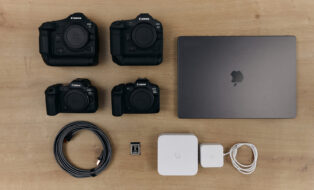
At Capture One we hold each other accountable for celebrating and protecting the work photographers do. We support those fighting to make the work they know is important (thank you, Seth Stern, you’re an inspiration). We own more cameras than we have employees. We run monthly internal photography competitions, we print the winners and we hang them on our walls.
None of this is normal for a software company.
Good.
We don’t aim to be normal. We aim to be right for photography.
So, when others zig, we zag. Soon, we’re launching Negative Film Conversion. Analog, yes.
And you might ask, why film?
To us, the answer is simple: photographers deserve tools that respect the full spectrum of their craft. Past, present, and future.
We’re not following the hype cycle or chasing trends. We’re building for the long arc of photography.
The Future We’re Building Toward
A future where photography is once again the main character. Where the photographer is the author, not the algorithm.
A future where AI isn’t the headline. Where tools fade into the background.
A future where photographers have room to think, space to create, and full authorship over their work. Where clarity and control return to the people who actually do the work.
Capture One’s role in that future is clear as day:
Build tools for photography and the people who practice it.
Everything else is noise.

Rafael Orta
Rafael Orta was appointed CEO of Capture One in December 2020. Originally a computer engineer who moved into marketing and management, Orta brings over 25 years of experience working with leading high tech and hard industry players. His passion for technology and innovation drew him to Capture One – and he believes firmly in putting the user community at the heart of decision-making.